Material - Shagreen/Galuchat in French Art Deco Furniture
Let's talk about shagreen. What is most often called shagreen (or large grained shagreen) is the skin taken from sea rays. These skins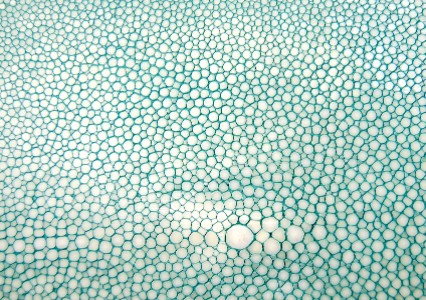
Ray Skin Shagreen leather, West Dean are covered with placoid scales or dermal denticles, which are fairly bubble-like pieces that are a lot like vertebrate teeth. The outermost layer of a hide is composed of an enamel-like material which is very hard and rough. This is the type of shagreen most frequently found on furniture.
There is another type of shagreen called 'small grained' shagreen which comes from the skin of sharks and Dogfish. This type of shagreen leather was known as roussette or rouffette in France eventually becoming known as Galuchat around 1762 as will be explained in a moment. This is the type of shagreen typically used on personal items.
Ray skin was traditionally prepared by soaking the skin in warm water for several days, scraping off the flesh, and drying it. The resulting material is stiff but flexible, particularly so when wet. As well as being durable and waterproof, an interesting aesthetic is created by the arrangement of the close set denticles, which are largest down the centre of the back and gradually diminish in size towards the edges. (Cathy Silverman, "Shagreen - The history and conservation of decorative ray skin in furniture", Thirteenth International Symposium on Wood and Furniture Conservation, p. 63)

Japanese Tanto Blade with Shagreen Grip, Denhams
The Japanese were the first to make use of shagreen, using it for sword grips and scabbards in the thirteenth century. They started using it on furniture meant for export to Europe in the late 16th century. It appeared in limited quantities on embedded in the lacquer on chests. Typically the shagreen was dried so that the denticles could be separated from the skin and sprinkled in the lacquer to provide a more even effect. (Denticles near the raised center of a ray's back were larger than those farther away from it.) Export of Japanese chests with shagreen continued until about 1640. As navigation improved, European sailors continued to expand their exploration of the world, making it possible for them to harvest rays or purchase their skins from those harvesting them in other countries. Dutch and English furniture-makers began using shagreen in the middle of the seventeenth century . The French began producing shagreen-covered furniture around 1730.
Much of the popularity of shagreen in the 18th century is credited to 18th-century Parisian tanner Jean-Claude Galluchat, who became the first noted European shagreen expert in the second half of the 1740s. He came up with a way to refine the skin using sandstone to polish it as well as a method for coloring it. One of his best customers was Madame de Pompadour, who purchased a large number of shagreen covered personal items from Galluchat. It was almost certainly because of this that the 'small grained' material came to be known as galuchat in France. It's popularity among the French aristocracy caused an increase in interest in the material throughout Europe during this period.
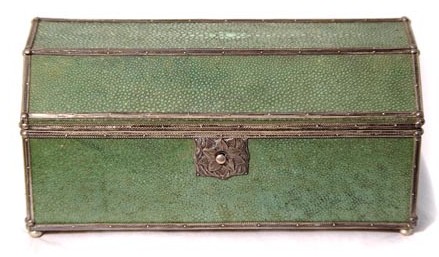
Small Box, Cedarwood with Shagreen Covering, John Paul Cooper,
1st Quarter of 1900s, Wikimedia
Since the 18th century shagreen has typically been used for covering portable items such as luggage, toilet cases and other boxes, the hard and robust looking finish seeming to assure its reputation for standing up to rough handling; book coverings are also known as well as larger pieces of furniture. The water-resistant qualities ascribed to the finish are probably why there are many toiletry cases and associated objects such as shaving kits, snuff boxes and other items of a personal nature. The restrained look of the skin was felt to be very suitable for men. ("Shagreen", Wikipedia, gathered 12-8-25)
Shagreen continued to be used throughout the 19th and into the 20th centuries, likely due to its unique properties. British Arts and Crafts designer John Paul Cooper created hundreds of personal small grained shagreen veneered items around the turn of the 20th century, combining it with precious metals and stones. Fellow English Arts and Crafts designer Omar Ramsden likewise produced a variety of similar personal items well into the 1930s.
Paul Iribe is often credited with bringing shagreen covered
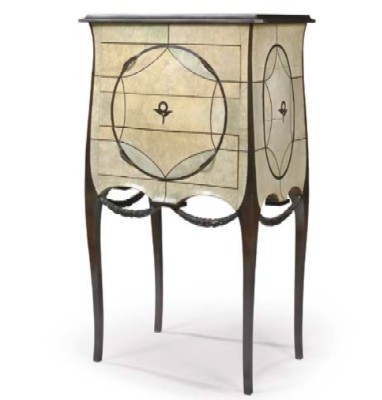
Small Chest of Drawers, Shagreen Covered Ebony with Marble Top,
c. 1912 Paul Iribe, Christie's
furniture back into the fashion public's eye in the 20th century. He had purchased an old stock of ray skins from a Parisian merchant around 1910. Intrigued by the skins, he decided to use them on a table he was designing for French fashion designer Jacques Doucet. He and Pierre Legrain had been commissioned by Doucet to furnish his apartment after Doucet decided to embrace the modern style around 1912. Iribe was unsure of how to use shagreen, so he asked sculptor Clément Rousseau for help. "Rousseau swiftly mastered the technique of ...stripping and cleaning the sharkskin [sic], tanning it, sanding and staining it, cutting it, gluing it to the item, and then varnishing it. Although galuchat was usually dyed green, Rousseau experimented with vegetable dyes to create a wide range of new colors (such as blue, grey, and pink)." ("Library table 01 - Clément Rousseau", Wikimedia, gathered 6-24-24)
Iribe is considered one of the earliest designers to blend what would became streamlined Art Deco with Art Nouveau's intricate floral style. In Art Deco fashion, he employed shagreen with other luxurious materials like ebony and marble in his designs. He combined cream and white pieces with green-tinted pieces. His foray into this field was relatively short-lived, however. By 1914 Iribe had ceased producing furniture. Although instrumental in introducing what Art Moderne elements in the early 1910s, Wikipedia states that he was critical of the seminal 1925 Exposition Internationale des Arts Decoratifs et Industriels Modernes, with Wikipedia reported that he referred to it as "the alliance between Art and the cube" ("Paul Iribe", Wikipedia, gathered 12-8-25) However, the reference they give for this does not support this assertion so without knowing the correct attribution, it is not certain that he actually said this.
Rousseau continued to design furniture after Iribe had moved on to other things with his first major public display
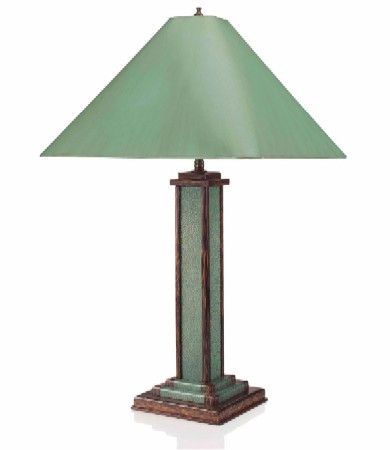
Table Lamp, Shagreen, Palmwood, Paper Shade, Clement Rousseau,
1923, Christies
of shagreen furniture appearing at the 1921 Salon des Artistes Francais. Although it was Iribe who had the idea of (re-)introducing shagreen to popular furniture design, it was Rousseau who had actually made it work. "His designs combine galuchat, sometimes in pink, gray, blue or green tones, with rare woods or other luxurious materials, including ivory and leather." ("A Palmier, Galuchat and Ivory Inlaid Table", Christie's, gathered 12-8-25) An article in 1925 explained that "during his apprenticeships in several furniture houses, he was captivated by the beautiful, rare, and difficult-to-work material that is sharkskin [sic]. But Rousseau loves a challenge, and after numerous attempts, he eventually mastered this rebellious material and succeeded in applying it to furniture and objets d'art." ("Un artiste angevin ressuscite l'art du 'Galluchat'"", L'Express d'Angers et de l'Ouest, 1925-12-20, p. 3) It goes on to note that he used "a process that is unique to him" to polish the lacquer-encased shagreen, "giving it the appearance of cloisonné enamel, with a shimmering luster, a surprising variety of tones, and unshakeable durability." ("Un artiste angevin ...", p. 3)
Rousseau advocated a return to the classical styles of the 18th and 19th centuries, becoming known for his use of shagreen. He was a regular exhibitor at the Salons of the Société des Artistes Français, winning an honorable mention in 1923 and a bronze medal in 1926 for his furniture designs. Writing in 1923, Gaston Derys exclaimed, "In the hands of a master craftsman like Clément Rousseau, shagreen becomes an admirable material, with moonlit reflections, lustrous like a velvety gem." (Derys, "Applied Art at the Galleria Museum", Les Modes de la Femme de France, 21 Janvier 1923, p. 13) He received a variety of prestigious commissions for shagreen pieces from Jacques Doucet, Duchesse de Vendôme and the Rothschild family.
"His work is characterized by great diversity and remarkable richness: pedestal tables, boxes, desks, lamps... His creations are extremely popular in today's interior design trends." ("Rating and value of furniture, tables, lamps by Clément Rousseau", Auctie's website, gathered 6-24-24) Unlike other designers who found the market for commissioned designs from wealthy patrons hard to come by in the difficult economy following the stock market crash of 1929, Rousseau remained focused on commissions. As a result, his designs were never mass produced, making Rousseau's furniture difficult to find in the resale market. It is likely also why so many of his designs are so precise and lovely.
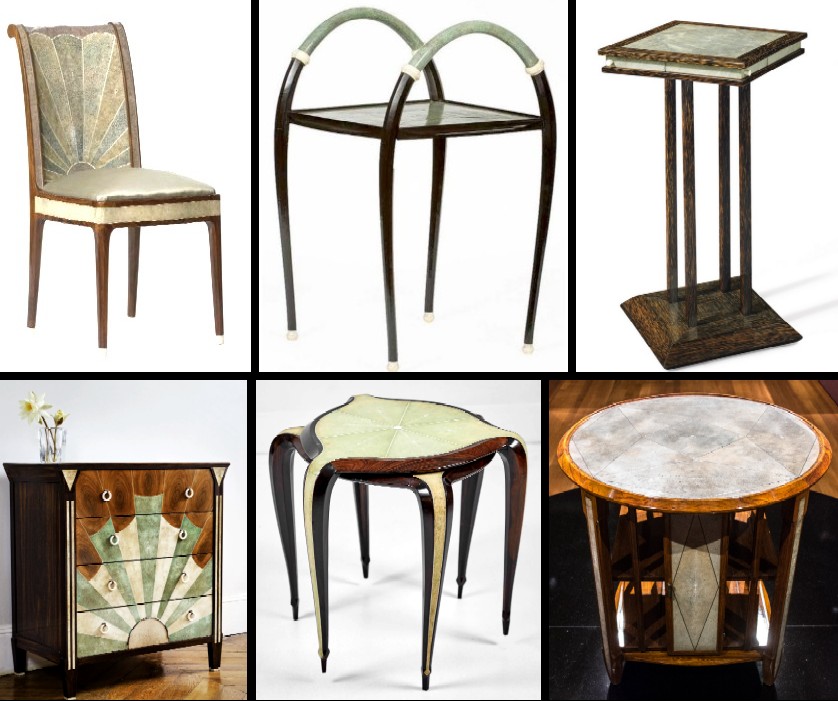
Shagreen Furniture by Clement Rousseau <Top> Chair, Rosewood, Shagreen, Ivory, Light Blue-Grey Upholstery, c. 1921, MAD Paris; Table, Ebony, Shagreen, Ivory and Brass, 1924, MET Museum; Smoker's Table, Palmwood and Shagreen, 1934, Christie's
<Bottom> Chest of Drawers, Macassar Ebony, Kingwood, Oak, Mother of Pearl, Shagreen and Ivory, c. 1925, Sotheby's; Three Legged Stacking Tables, Rosewood and Shagreen, Clement Rousseau, 1930s, 1st Dibs; Lbrary Table, Rosewood, Shagreen and Ebony, c. 1920, Wikimedia
Iribe's use of shagreen, further popularized during the Interwar era by Rousseau, likely caused it to be used by others. Probably best known for their early adoption and widespread use of shagreen were André Groult and Jean-Michel Frank.
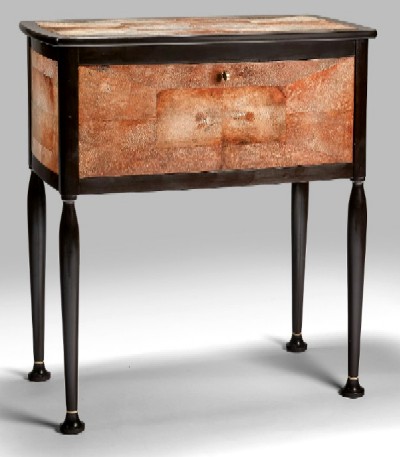
Lady's Writing Desk, Andre Groult, Ceylon Ebony, Resin and
Shagreen,
c. 1913, Christie's
Groult was a friend of Jacques Doucet making it possible that he came into contact with shagreen through Iribie's work with Doucet. An article written about the upcoming 1925 Exposition states, "Messrs. [Adolphe] Chanaux and [Gilbert] Pelletier were the first—at the instigation of Mr. André Groult, around 1910—to apply it extensively to furniture." (Yvanhoé Rambosson, L'Exposition de 125", Comedia, 26 February 1923, p. 4) Chanaux and Pelletier were partners in the eponymous luxury furniture manufacturing firm Maison Chanaux & Pelletier which was established in 1920. Chanaux had trained under Groult and would go on to work with Jean-Michel Frank who will be discussed shortly. In addition to getting this fact wrong, Rambosson's dating is vague. As early as 1913, Groult designed and created writing desks with patterned shagreen coverings, perhaps in conjunction the Maison. He continued to use the material long after that. For the 1921 Salon des Artistes Décorateurs he created a room that was "made of shagreen", here using tan skins with pink brocade. Of his design, Madeleine Fleury opined,
Reviving shagreen and using it to cover the entire surface of a piece of furniture is a bold undertaking, but this whim will not last: besides the very high cost, the durability does not seem guaranteed, and the beauty is truly relative, especially since, to suit this eccentric material, furniture has been given bizarre shapes." (Fleury, Les Veillées des Chaumières, 01 October 1921, p. 766)
She did say that she liked the choice of pink fabric, however.
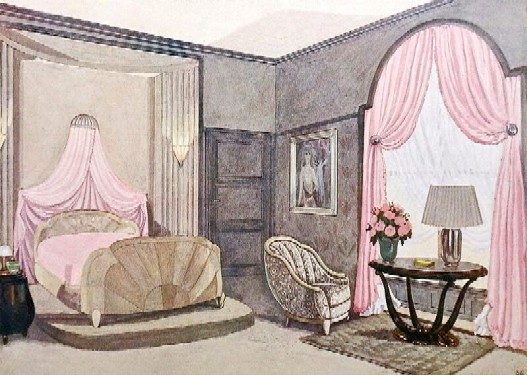
Woman's Bedroom, Design by André Groult, Interieurs en Coleurs, 1926, Plate 18
Groult's his best-known example of the use of shagreen were the various pieces he created for the Woman's Bedroom in the French Ambassador's pavilion sponsored by the Société des Artistes Décorateurs at the 1925 Exposition Internationale des Arts Decoratifs in Paris. The bed featured a sunrise pattern created in ivory colored shagreen. Tucked into a corner of the room was a bulbous and strikingly feminine mahogany cabinet covered in in a similar shade of shagreen with rays radiating out from three different circular designs, one in the lower part and two near the top. He called it the Chiffonnier Anthropomorph. Another dresser featured similar designs created in shagreen which was parked behind one of his scalloped back chairs. Although I haven't found proof of this, it is likely that the top of the chair was similarly covered in shagreen.
Like Madame Fleury's opinion of his use of shagreen in his design for the 1921 Salon des Artistes Décorateurs , not everyone was a fan of the shagreen-covered furniture in the 1925 Exposition. In an interview given in July of 1925 concerning his Woman's Bedroom, Groult explained,
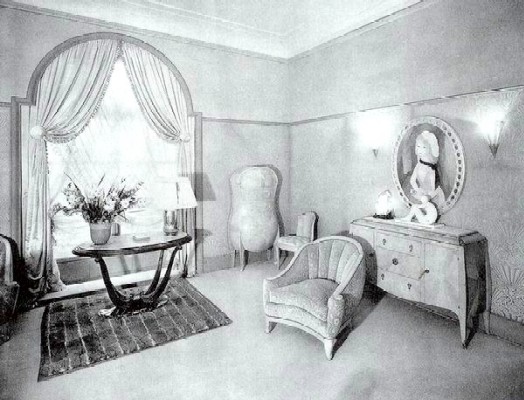
Woman's Bedroom, Photo, André Groult,1925, Amerelife
A critic, speaking of the Ambassador's bedroom, recently reproached me for having covered wood with shagreen, whereas, according to him, this wood used alone would have given a similar result. This reproach would have been even more bitter had he known that this shagreen was veneered onto solid mahogany, that is to say, onto a wood that was already precious. If I were inclined towards controversy, I would have replied to this critic that shagreen is an infinitely more precious material than wood, that it has a higher hardness coefficient than any other material normally used for furniture making, that it acquires exceptional qualities with use, that it allows for profiles that wood simply cannot achieve, that, when hammered flat without a wedge, it simplifies the process of designing shapes and allows for the creation of a series of similar pieces, each evolving towards greater perfection, without forcing you to make two pieces to achieve the same result. Finally, I would argue that it is difficult enough to work well to tempt those who are interested in a challenge. (Gaston, Bernheim-Jeune, "Les Prédilections De M. André Groult", Le Bulletin de la vie Artistique, 15 July 1925, p. 309)
Of course, this was just one opinion. Speaking two years after the event, Gaston Derys exclaimed, "I will always remember that lady's bedroom, entirely in shagreen, by André Groult, in the Embassy Pavilion at the 1925 Exposition. What freshness! What reflections of pearl and dawn!" (Derys, "Le Salon des Decorateurs", La Femme de France, 17 July 1027, p. 25)
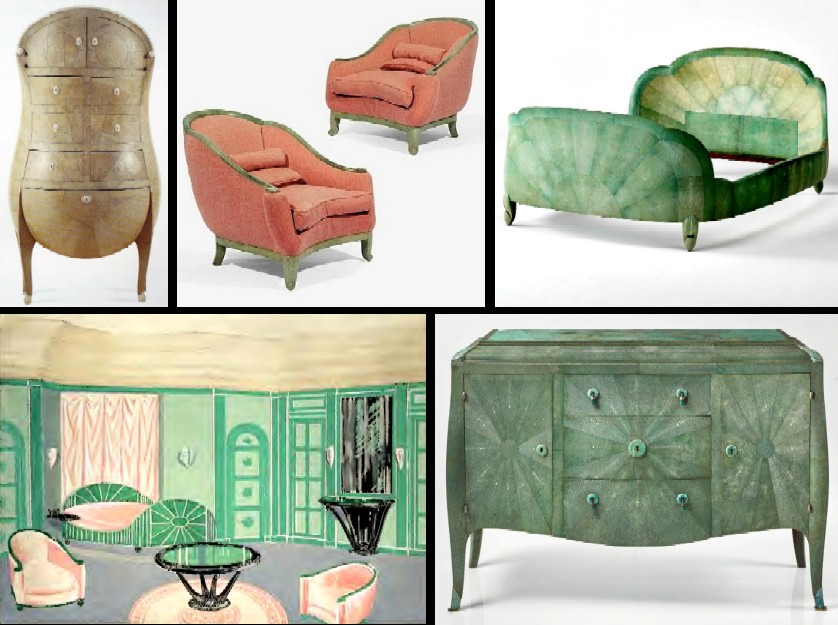
Shagreen Furniture by André Groult <Top> Chiffonnier Anthropomorph, Shagreen Covered Wood, 1925, MAD Paris; Pair of Bergere Armchairs, Stained Shagreen Reupholstered, 1925, Mutual Art; Bed. Mahogany and Oak Covered in Shagreen, c. 1925, Christie's
<Bottom> Project Room for Ladies, Shagreen Bed and Chair Surfaces, Ebony Table and Console with Amazonite Top, Les Arts de la Maison, Spring, 1925, Editions Albert Morance, Plate III; Commode, Mahogany with Shagreen Covering, marble, Amazonite and Silvered Bronze, c. 1926-8, Artsy
Jean-Michel Frank was a Modernist who emphasized minimalism, using exotic luxurious materials like shagreen, gypsum, mica, plaster, vellum, obsidian and terracotta to create intricate veneers in his

Desk and Chair, Shagreen Covered Wood, Purple Silk Fabric Upholstery,
Jean Michel Frank, c. 1930, Artsy
furniture. He sought different pieces of the same material with varied textures and coloring, placing them in appealing patterns on his furniture. His first furniture project was for a friend in 1920, consisting of tables wrapped in shagreen. "Shagreen is one of the materials that Jean-Michel Frank is famous for 'bringing into the light'; using it on furniture, lighting and accessories. ...he saw its beauty in broad oblongs of ivory or chocolate tones – the subtle natural variations bringing a sense of rawness coupled with luxury when applied to simple structures." (Alexander Lamont, "A vision of Jean-Michel Frank", blog, gathered 12-9-25)
While Frank's connection to the material is undoubted, by the time he produced the tables for his friend all three of the other artists mentioned had been working with the material for nearly a decade. This isn't to say that Frank might not have 'discovered' it on his own, just that he was not the first artist popular in the interwar period to bring the material to the public eye. Where the others are is connected to 'galuchat' in magazines during the 1920 and 30s, Frank's connection is primarily found in retrospectives. Although all the designers working in shagreen were designing for the upper class, his work appealed to a particularly elite, fashion-conscious clientele. He certainly made good use of the differing colors and designs found in shagreen in his patterned designs. Unlike many of the other designers already discussed, he always appears to have used it untinted and tended to use it on flat surfaces for the most part.
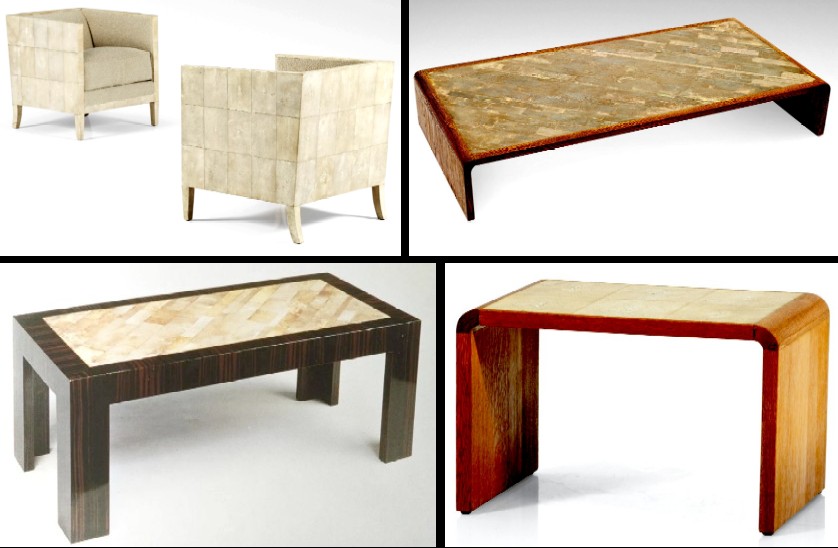
Shagreen Furniture by Jean-Michel Frank <Top> Pair of Armchairs, Shagreen Covered Wood and Upholstery, c. 1928, Sotheby's; Coffee Table, Shagreen Covered Oak, c. 1930, Gallery BAC
<Bottom> Table, Ebony with a Patchwork Shagreen Top, c. 1928, Alexander Lamont blog; Low Table, Oak with Shagreen Top, c. 1930, Sotheby's
Another designer who created several pieces of furniture with shagreen coverings was Pierre-Emile Legrain. Legrain met Paul Iribe in 1908 and it is probably through this connection that he became Jacques Doucet's principle designer when Iribe left for America in 1914. Doucet was apparently a fan of the material, perhaps because of Iribe and Rousseau's designs for him. While there is less of Legrain's shagreen pieces they are often very interesting designs.
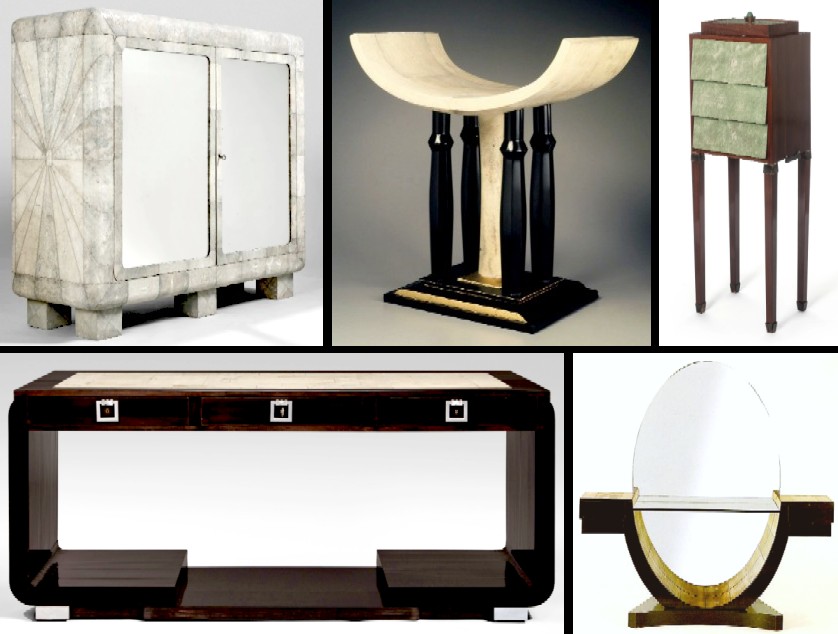
Shagreen Furniture by Pierre Legrain <Top> Cabinet, Birdseye Maple with Shagreen Covering, Mirror, c. 1920, Mutual Art; African-Inspired Stool, Lacquered Wood with Shagreen Covering, Pierre Legrain, c. 1923, Artnet; Cabinet for Jacques Doucet, Rosewood, Shagreen, Jade, Horn with Sycamore Interior, c. 1919, MAD Paris
<Bottom> Desk for Jacques Doucet, Ebony with Shagreen Top, Burled Maple Drawers and Silvered Bronze Hardware, c. 1923, Sotheby's; , Vanity, Ebony with Shgreen Covered Surfaces, Glass and Mirror, c. 1920, Pinterest
A variety of other designers used shagreen in their designs during the interwar period, almost certainly inspired by the work of those mentioned. Like Legrain, these designers were likely introduced to shagreen by Groult. This was definitely the case with Chanaux and Pelletier who created pieces for Groult, but were designers in their own right. They produced several pieces of Chanaux's design. Other popular decorators likewise experimented with shagreen. Writer Derys gushed about 'rediscovering' the material in something Léon & Maurice Jallot presented at the 1927 Salon des Artistes Décorateurs without saying exactly what it was. Emile-Jaques Ruhlmann created a desk with a shagreen pattern on top for the 1925 Exposition's Embassy Pavillion in his usual flowery style.
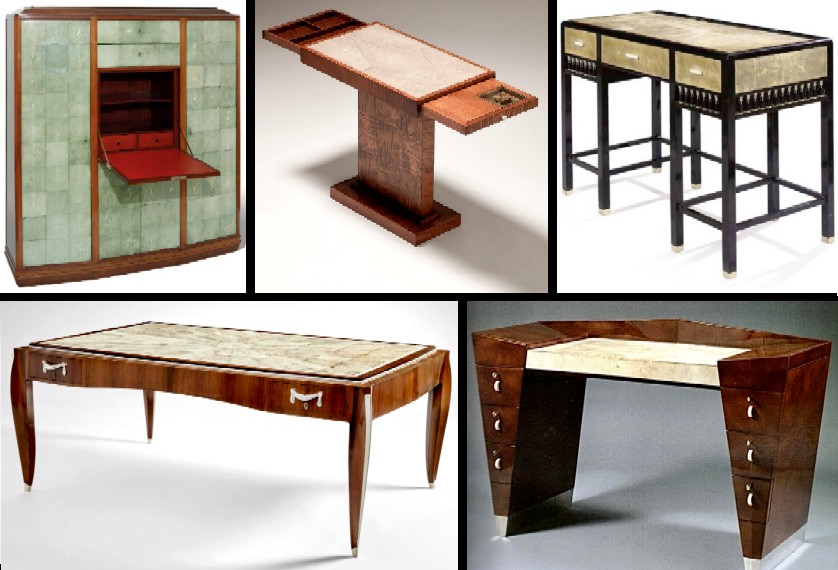
Shagreen Furniture by Various Designers <Top> Secretary Desk, Rosewood, Sipo, Shagreen and Red Leather, Adolphe Chanaux and Gilbert Pelletier, 1925, Christie's; Smoking Table, Ash Burl Veneer with Shagreen Top and Nickel-plated Bronze Ashtray, Leon and Maurice Jallot c. 1930, Instagram; Lady's Desk, Ebony with Ivory and Galuchat Covering, Attr. Adolphe Channaux, c. 1920, Christie's
<Bottom> Desk for the Embassy Pavillion, Rosewood with Shagreen Top, Ivorine and Silvered Bronze Fixtures, Emile-Jacques Ruhlmann, 1925, Sotheby's; Cubist Desk, Lacquered Oak with Shagreen Desk Surface, Ivory Pulls and Silvered Bronze Feet,Leon and Maurice Jallot c. 1930, Facebook
The use of shagreen on furniture in interwar France appears to have been focused primarily in the 1920s. It almost exclusively found on higher end items, probably because of the skill required to use it in a way that created appealing designs. While there are some examples of shagreen covered furniture from the 1930s, it appears to have declined in use during the economic decline of the 30s. items This was not the end of its use. A variety of designers used shagreen as it had been employed in Europe since the 16th century - as decoration on smaller items such as jewelry, small cases and boxes and similar personal items. Such uses would take an article of their own to highlight.
Sources Not Mentioned Above:
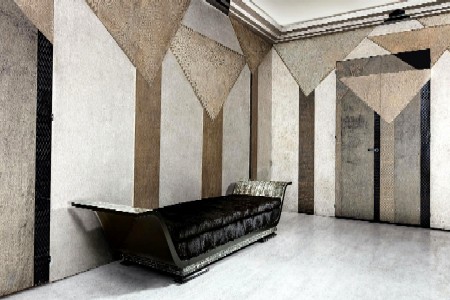
Smoking Room, Les Palmiers, Laquered Panels, Engraved Metal Plates,
Shagreen Designs by Katsu Hamanaka, Abstract Forest Theme, Jean Dunand,
1930-6, Home Journal
Joanne Quinn, "What is Shagreen?", Lux Deco website, gathered 12-6-25
Betsy Riley, "Art Deco favorite Shagreen makes yet another comeback", Atlanta Magazine website, gathered 12-6-25
"Jean-Claude Galluchat", French Wikipedia, gathered 12-7-25
Nicolas Violett, "The Beauty & History of Shagreen", Atelier Violett, gathered 12-6-25
"What's the difference between small- and coarse-grained shagreen?", Maison du Galluchat website, gathered 12-8-25
"Paul Iribe", Primavera Gallery website, gathered 12-8-25
"The Sculptor Clément Rousseau's Opinion on the Future of Contemporary Furniture", Comedia, 26 November 1930, p. 3
Ben Weaver, "Jean-Michel Frank", The London List, gathered 12-9-25
"André Pierre Emile and Nicole Groult", The MET website, gathered 12-9-25
"André Groult (1884-1966) Writing Desk, circa 1913", Christie's website, gathered 12-9-25
"Adolphe Chanaux", French Wikipedia, gathered 12-11-25