Cubism
Cubism is a form of 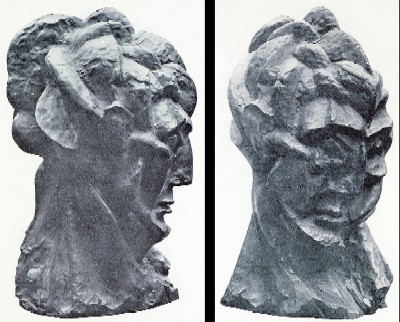
Head of a Woman, Bronze Cast, Pablo Picasso, 1909-10. Blue Mountain
Project, Princeton University, Wikipedia
art which breaks a subject into different parts (or cubes), turning these 'cubes' so that each showed a different, independent perspective and stylizing the contents by reducing that part of the subject into its basic geometric forms. The concept was originated by painters Pablo Picasso and Georges Braque around 1907-8, their artwork being influenced by some of the works of Paul Cézanne. "Cézanne believed nature could be reduced to sculptural forms such as cylinders, spheres and cones and had developed a flat, two dimensional view of the landscape." ("Cubism and its influence on Art Deco Design", Decolish website, gathered 5-12-25) This embryonic phase of Cubism lasted until about 1910. Two later phases of Cubism were identified by art historians post facto.
This first phase is referred to as Analytical Cubism, with examples appearing between 1910 and 1912. It consisted of multiple, fragmented views of an object with each 'cube' showing that part of the subject from an independent point-of-view. "It is termed analytical cubism because of its structured dissection of the subject, viewpoint-by-viewpoint, resulting in a fragmentary image of multiple viewpoints and overlapping planes. Other distinguishing features of analytical cubism were a simplified palette of colours, so the viewer was not distracted from the structure of the form, and the density of the image at the centre of the canvas." ("Art Term: Analytical Cubism", Tate Galleries website, gathered 5-15-25)
The second phase is defined as Synthetic Cubism,
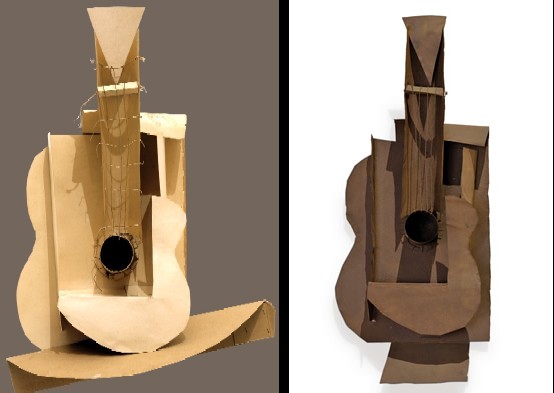
Cubism, Guitar Sculptures, Cardboard & Paper | Sheet Metal, Picasso, 1912, Rachel Holloman Art
with examples appearing between 1912 and 1914. Here, artists flattened the image and removed the allusions to three-dimensional space (softening the edges between the 'cubes'), using simpler underlying shapes and adding bold, bright colors, textures and patterns.
Moving Cubism from two dimensional artwork to three dimensional space and furniture presented some challenges, although Picasso did just that in both styles. An early example which fits in the Analytical style was his sculpture of the head of a woman. (See the image above left.) As Picasso embraced the Synthetic Cubism style, he began pulling objects apart and reassembling them, leading him to create Cubist collages which were less strictly structured and more focused on the geometric parts. (See the two images of his guitar sculpture at right.) This was more in line with the way French Art Deco designers employed Cubism. The Tate Galleries website explains that it was "the influence of cubism which gives art deco design generally a more fragmented, geometric character." ("Art Term: Art Deco", Tate Galleries website, gathered 5-13-25)
Czech Cubism
Although Cubist art began in France it was initially more important to interior design in Bohemia (modern Czech Republic). Cubist-inspired architecture and furniture became very popular nearly a decade before it was fully incorporated it Art Deco era designs. Bohemian artists were searching for a style of their own in 1910, one
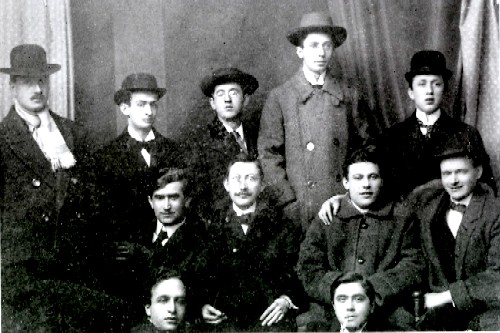
Group of Fine Artists (Skupina výtvarných umělců), 1911. flickr
Top from Left:
Vincenc Beneš, Otto Gutfreund, Josef Čapek, Josef Chochol, Karel Čapek;
Middle: Josef Gočár, Vilém Dvořák, Vlastislav Hofman, Pavel Janák;
Bottom: František Langer, Jan Thon
different from the Viennese style that was dominant in Prague at that time. Sculptor Otto Gutfreund and painter Emil Filla, both of whom had visited France before 1910,
where they "were drawn to the radical cubist paintings of Picasso and Braque-and cubism’s celebration of the freedom of individual thought and imagination." (Rosalind Pepall, "What Picasso inspired in Prague: The brief, bold flourishing of Czech cubist group of design and architecture", The Magazine Antiques website, gathered 5-15-25)
While Cubism jad found support in Bohemia in painting and sculpture around 1910, thanks to Gutfreund and Filla, it extended beyond the pure artistic fields, reaching other creative fields including architecture, design, and the decorative arts In May of 1911, Filla and Gutfreund joined Josef Gočár, Pavel Janák, Vlastislav Hofman, František Kysela, Zdeněk Kratochvíl, Ladislav Šíma, and Václav Špála forming the avant-garde Group of Fine Artists (Skupina výtvarných umělců) in Prague. Several other painters, sculptors, architects, designers, illustrators, art historians, and art critics joined the group in the next couple of years. Czech students were trained in the study of geometric shapes which they considered the basis of beautiful form. With this background, the breakdown of objects into their geometric parts would have appealed to such designers.
Architect Pavel Janák was one of the central figures in Czech Cubist design. Janák was inspired by the flat surfaces, sharp edges, and oblique lines found in crystalline structures as he explained in his article The Prism and the Pyramid in the first edition of Artistic Monthly (Umĕlecký mĕsíčník), the magazine published by the Group of Five.
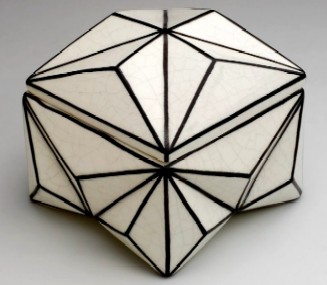
Crystal-Shaped Container, Glazed Ceramic, Pavel Janak for
Artel, Museum of Modern Art, 1911, Google Arts and Culture
He explained, "The spirit of the new style is already defined, and the road to its plastic means by penetration to the very nature of matter is clear: it includes geometric forms, prismatic and cubic, the most intrinsic essentials of all forms, purged of everything secondary; their natural constructive arrangements are the new compositional principles." (Janák, cited by Pepall) Janák's design for a small box (seen in the first image below) displays the characteristics he mentioned.
Czech Cubist furniture and other design items from the Group during the first half of the 1910s had sharp points, sliced planes, unusual angles and crystalline shapes similar to Janek's small crystalline box. "They believed that objects carried their own inner energy which could only be released by splitting the horizontal and vertical surfaces that restrain the conservative design and 'ignore the needs of the human soul.'" ("Czech Cubism", Wikipedia, gathered 5-15-25)
One of the key characteristics of Czech Cubist architecture is its emphasis on fragmentation and deconstruction. Architects embraced the notion of breaking down traditional architectural elements into smaller components, creating a sense of dynamism and movement. This fragmented approach is evident in the intricate facades of Cubist buildings, where windows, balconies, and decorative elements are designed to appear as though they are in a state of constant transformation. (Vanda Svobodova, "The Legacy of Czech Cubism: Unique Architectural Wonders", Czech Journal website, gathered 5-16-25)
The first building erected in Czech Cubist style was a department store in downtown Prague designed by architect Group member Josef Gočár in 1911 which he designed for merchant Josef Herbst. It was completed in 1912, replacing the baroque House at the Black Madonna. The New House of the Black Madonna was designed in Modernist Cubist style although Gočár incorporated some baroque elements to satisfy public requirements. Cubist elements include the entry, dormer windows, wrought-iron grille and the staircase balustrade. The interior walls with painted with geometric designs. After 1922, it was remodeled as office space, destroying many of the Cubist elements. It was restored between 1993-4 and today houses the Museum of Decorative Arts with a permanent display of Czech Cubist rooms and furnishings (many of them by Gočár).
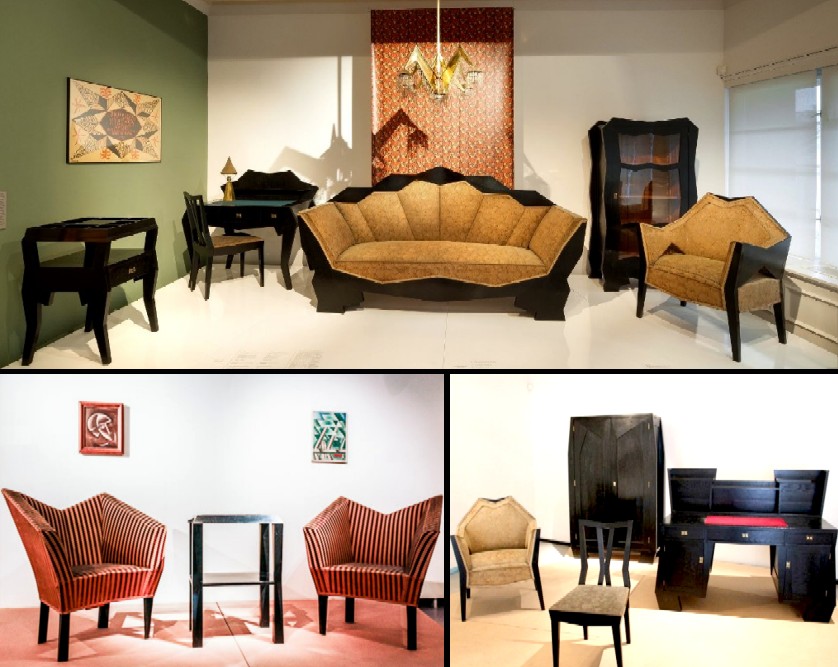
Czech Cubist Furniture at the Museum of Decorative Arts, Prague, from top left - Living Room with Cubist Furniture and Chandelier, Josef Gočár and Josef Chochol, 1913, Google Arts; Chairs with Table and Cubist Art, Probably by Pavel Janák or Josef Gočár, c. 1913, A Lady in London; Desk, Cabinet and Chairs with Ebonizing, c. 1914, Tastetravel
In the area of the decorative arts, Czech Cubism was pervasive among the
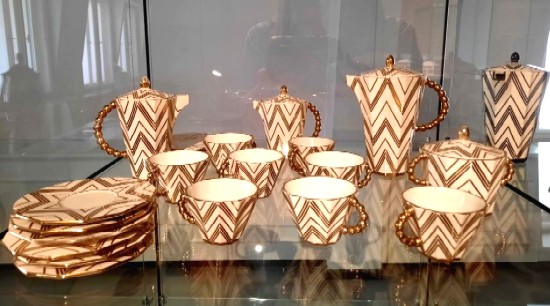
Czech Cubist Tea Service - Cups, Pitchers and Plates, Ceramic, Pavel Janek, 1911-2,
Salterton Arts Review
creations of the Group of Fine Artists. Every aspect of decor was given their fragmented, geometric Cubist treatment: furniture, fabrics, lighting, wall coverings, mirrors, rugs, ceramics, tableware... even lamp posts! Janak and Gočár both contributed a variety of designs to the decorative arts along with several other members of the Group including Josef Chochol, Vlastislav Hofman, and František Kysela. See the examples in the images below for more from these designers.
Interestingly, the fragmented design approach often looked very much like the design style called 'Zigzag Moderne' style, which was associated particularly with some of the European Art Deco styles of the 1920s. (See the tableware at left for an example of this.) Note also how many of these designs have the basic color palette which early French Cubist artists adopted during their 'Analytic Cubism' phase.
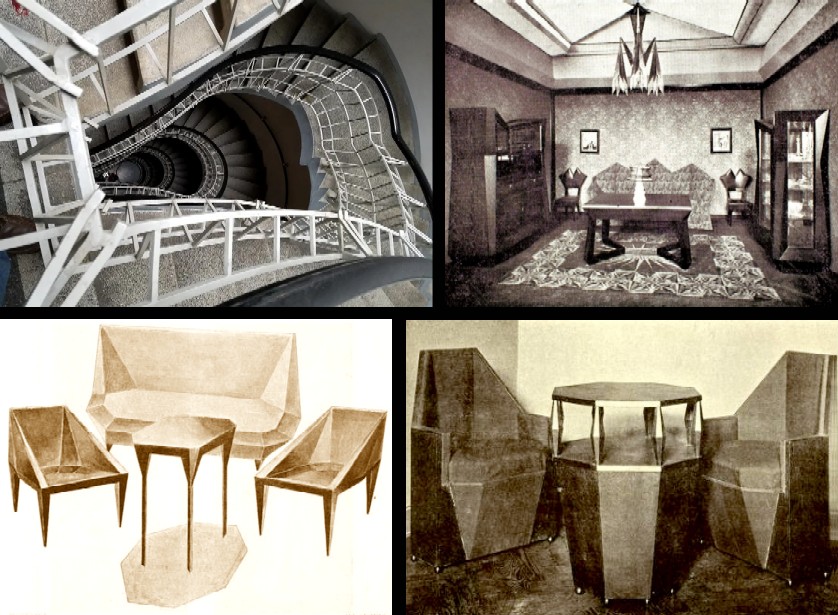
Czech Cubist Furniture Designs from the 1910s, from top left - Staircase at the House at the Black Madonna, Josef Gocár, Photos by Fredric Swanson, 1912, Medium; Living Room, Furniture and Chandelier by Josef Gocár; Wallpaper and Carpet by František Kysela, Prague Art Workshops display at Deutscher Werkbund Exhibition, 1914, The Magazine Antiques; Living Room Furniture Design, Vlastislav Hofman, Skupina výtvarných umělců, 1911-13, NYPL Digital Collections; Lounge Furniture, Josef Chochol, 1911-2, NYPL Digital Collections
When the Autro-Hungarian empire entered World War I in July of 1914, the production of the decorative arts ceased in Bohemia. Following the end of the war in 1918, Bohemia became part of Czechoslovakia. The sharp planes and broken edges of the crystalline Cubist style were modified, becoming a new style.
For those interested in seeing more examples of Czech Cubism in architecture and the decorative arts, check out this web page.
Rondocubism
Cubist designers in architecture and design adopted a less radical approach to their designs, which is sometimes referred to as 'rondocubism' or 'curved cubism'. This style included semicircles, circles and ovals which had largely been absent from the earlier style, with these new elements intended to reflect national Slavic traditions. Rondocubism impacted the international design approach of the 1920s and early 1930s, with the French and other countries incorporating 'curved cubism' elements into their architecture and decorative arts.
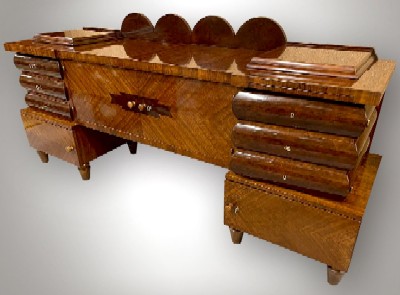
Rondocubist Buffet, Mahogany and Macassar Ebony, Restored,
c. 1925, Novy Antik Bazar
The rounded forms can be found in nearly all of the Rondocubist designs in the 1920s, sometimes excessively so. (See the buffet at right.)
Forms based on the circle and cylinder, complemented by bright colors, eventually completely prevailed, certainly also in connection with the events of 1918 [the creation of Czechoslovakia]. In a period of strong patriotic ideas and great euphoria in society, arising from the newly acquired freedom, the new style of Janák and Gočár found understanding in the special '... foundation of the nation, which has always been directed more towards the spirit than the body, ...' [Pavel Janák, K situaci ve stavebnictví, Styl I (VI), 1920 – 1921, p. 21-22] In contrast to the revolting cubism, we feel stability and positive expressive charge in the work of both architects after 1918. (Blanka Přikrylová, "Rondocubist furniture of Josef Gočár and Pavel Janák", Master's Thesis, 2009, Univerzita Palackého, p. 48-9)
As noted in the previous quote, the new style included a great deal more ornamentation in its designs, practically abandoning the zigzag elements found in the previous Czech Cubist phase (1911-4).

Rondocubism, Legion Bank Lobby Entrance, Prague, By Josef Gocár,
Photo Ondrej Tomšu, Built 1923, Radio Prague International
The architects of that time were intoxicated by the freedom of the new independent state and sought an architectural expression that would demonstrate the uniqueness of Czech culture. To create a purely national style, they drew inspiration from traditional patterns of folk architecture, which they complemented with a palette of national colors in subdued shades such as ochre, beige, or sienna." ("Rondocubist route", Mapamátky Association website, gathered 5-18-25)
As he had done during the Czech Cubist movement, Janák wrote about the style which would have further publicized it. Later, looking back on the new style, Janák called it
...a return to traditional folklore, and a connection with life in the broader sense. It was primarily a reaction against pre-1918 artism. Now architects sought forms that would accommodate the general popular understanding. Already here it contains the beginning of a major change from an individual artistic form to a broader general comprehensibility and utility, even at the price of a reduction in expressiveness." (Pavel Janák, "Čtyřicet let nové architektury za námi – pohled zpět," Architektura 2, 1940, cited by Vendula Hnídková, "Rondocubism versus National Style", RIHA Journal 0011, 08 November 2010)
The primary drivers of Rondocubist furniture design in the beginning of the design period (~1918) were the same two architects who drove Czech Cubist movement: Janák and Gočár. "From 1918 onwards, when the Hapsburg Empire crumbled,

Rondocubist Armchair and Table, Painted Wood and Fabric, Josef Gocár,
1922, Salterton Arts Review, Salterton Arts Review
Gočár and his colleague from the Czech Cubist movement Pavel Janák were at the forefront in developing a 'national' style to celebrate independence, which became known as Rondocubism." (Brian Kenety, "Josef Gočár: pioneer of Czech Cubist, Rondocubist architecture, and designer extraordinaire", Radio Prague International website, gathered 5-19-25)
Janák and Gočár produced furniture in the new style from their Prague Art Workshops (P. U. D.), a company which they established In 1912 with designer Josef Chochol relying on the financial support of Dr. Odolen Grégr. The company had originally been started to create the complicated Czech Cubist furniture of the 1910s with its unusual sharp angles, edges and oblique joints which were difficult for ordinary carpentry workshops to produce. Gočár also became the head of the Union of Czechoslovak Works with Janák as the executive director in 1920. The organization published its own magazine Výtvarná práce, promoting the national decorative style in applied art as well as organizing lectures. competitions and exhibitions. In addition, the style was propagated through the Prague School of Applied Arts where artists such as Janák and František Kysela worked as teachers.
The 1925 Exposition Internationale des Arts Décoratifs et Industriels Modernes) provided an opportunity to present the Czechoslovakian style to the world. The display for the exhibition was organized by the Union of Czechoslovak Works. Among the displays was František Kysela's tradition-inspired Rondocubist tapestries appeared at the 1925 Czechoslovakian Pavillion, Exposition Internationale des Arts Décoratifs et Industriels Modernes in Paris. These tapestries feature some of the Cubist elements from Czech Cubism but also have a strong traditional feel, even to the point of representing the trades shown with traditional machines. However, it was this event which caused the Czechoslovakians to focus on "practicality, economy, and purity of form", a move towards functionalism.
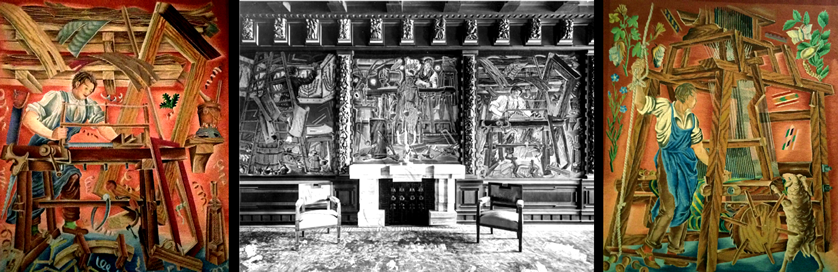
Czechoslovakian Pavillion at the Exposition Internationale des Arts Décoratifs et Industriels Modernes, Rondocubist Tapestries by
František Kysela, 1924, Robbie Lafleur
Some refer to Rondocubism as Czech Art Deco, which is not surprising given that it shared much in common with the Art Deco styles of the 1920s found in designs created in other countries. Blanka Přikrylová disagrees, noting that international Art Deco style (of the 1920s) was "characterized by the use of exclusive materials, an emphasis on elegance and richness of forms, luxury and refinement, its products were expensive and intended for the highest strata of society."
Although we can certainly find examples of the Art Deco style in Czech applied art and furniture design of the early 1920s, this is certainly not true for them in general. Most of the applied art and furniture items were aimed at a wide range of people, often directly at the less wealthy (although it was rare for furniture to be designed in a way that would be truly widely available). (Přikrylová, p. 52)
In addition, the nationalistic designs gave it a distinct look. This is similar in some ways to the way the Swedes created their Swedish Grace style during the Art Deco era which incorporated Nordic folk motifs in its design. Like Rondocubism, Swedish Grace is considered similar to Art Deco but distinct from it in this way.
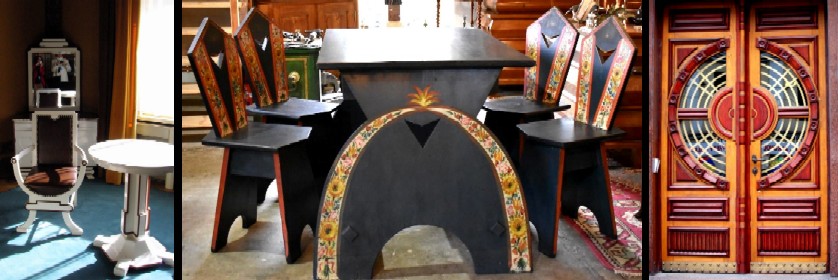
Rondocubist Furniture Examples, from left - Rondocubism, Chair, Vanity and Table, Tracy's Travels; Table with Four Chairs, Painted Wood. c. 1920, Lucicky Mlyn; Doorway of Palác Archa, Josef Gocár, 1921, The One Armed Crab
International Interior Design Influence of Cubism
Although the Bohemians (after the war, Czechoslovakians) were the first to really incorporate Cubist styles into
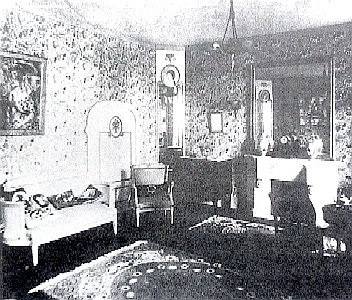
Cubist Influences, Le Salon Bourgeois in la Maison Cubiste,
André Mare & Others,
Salon d'Automne, 1912, Wikipedia
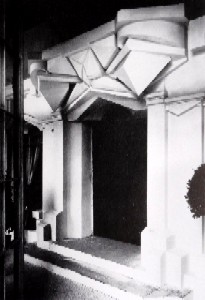
Cubist Influences, La Maison Cubiste,
Salon d'Automne, Raymond
Duchamp-Villon, 1912, Wikipedia
interior design outside of sculpture and artwork, they were not alone. Not long after the Bohemian started producing Cubist furniture, the French were embraced Cubism in design, although initially only to provide a showcase for the artwork of this new French style. This was the point of La Maison Cubiste (The Cubist House) which was presented at the 1912 Salon d'Automne in Paris. Architect Raymond Duchamp-Villon created an exterior house façade and André Mare designed a living room and bedroom for the display of Cubist art in conjunction with other designers. Both the façade and rooms were fairly traditional in design, although some hints of cubist elements and geometric shapes are apparent. Le Corbusier was said to be inspired by La Maison Cubiste, although his own designs leaned more towards Modernism than Cubism.
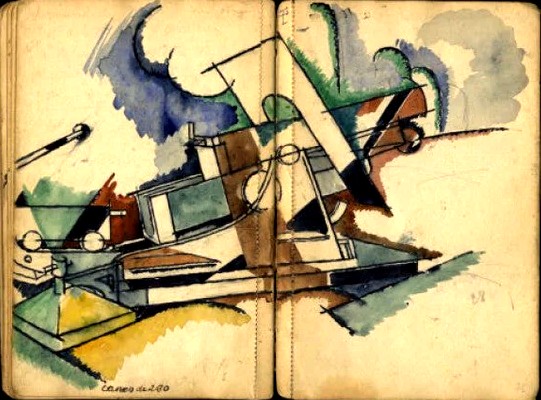
Camouflage Pattern by Mare, Le canon de 280 camouflé, carnet de guerre no. 2, 1915, Ideel Art
Being an artist first, André Mare's Cubist designs appear more in his art than in the commercial designs he later helped create. He was called to serve in the British military during the First World War, where his knowledge of Cubism can be found in his camouflage designs. Fortunately, Mare kept a series of notebooks during the are which provide us with vivid examples of his camouflage designs. (See the image at right.)
After the war, Mare joined fellow artist and designer Louis Süe to create the Compagnie des Arts Français (French Arts Company). Like Mare, Süe had been exposed to Cubism around 1910 and become interested in the style, incorporating it into some of his designs. During their partnership in the 1920s, the pair produced items and decor which incorporated designs from a variety of styles including some which was inspired by Cubism.
Other French designers embraced
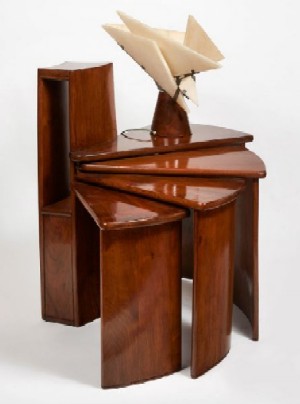
Fanning Telephone Table with Religeuse Lamp,
Walnut and Wrought Iron.Pierre Chareau, 1924,
Art Deco Society of New York
the new Cubist style in the 1920s, including interesting fragmented planes and simplified geometric forms in their designs. Based on the manner that such designs share with the Cubist furniture movement in Bohemia, they were likely inspired by them.
French Modernist Pierre Chareau introduced decorative multifaceted, smooth surfaces inspired by Cubism in furnishings beginning in 1922. Cubist facets appear in several of his designs including his 'religeuse' lamps, seats and tables. His hinged fanning telephone table suggests the movement of multiple fragmented planes by its motion and position. (See the image at right.)
 C
Cubism, Armchair, Ebony, Vellum, Mother-of-Pearl Inlay,
Velvet Upholstery Marcel Coard, c. 1920, Sotheby's
Marcel Coard had an abiding interest in supporting and producing avant garde designs such as Cubism. This began after selling his own vast collection of 18th century artwork in 1912, dismissing it as “the collection of my grand-father”. ("Marcel Coard | Unique Armchair", Sotheby's website, gathered 5-16-25) Coard personally knew the Parisian Cubist artists including Braque, Picasso and Robert Delaunay, and Pablo Picasso, "adapting many of their cubist ideas into his furniture design." (Andrew Mooney, Article on Coard, Facebook, gathered 5-16-25) An example of a Coard designed armchair appears in the image at left.
Irish-born Eileen Grey moved to Paris in 1900 where she attended Académie Julian. There she was exposed to the development of the Cubist movement. "Eileen Gray’s furniture designs, interiors, and houses seem to translate the artistic development of Cubist art into three dimensions." (Rosamund Diamond, "Eileen Gray and the influence of Cubism", Docomomo Journal #60, 2019, p. 79) Diamond goes on to compare Gray's use of moving and pivoting furniture to the works of contemporary artist Marcel Duchamp.
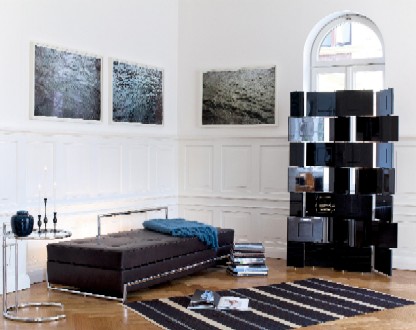
Cubism in a Family Room, Chromed Steel Adjustable Table and Daybed
Frame,
Lacquered Cubist Screen, Eileen Gray, 1920s Design, Limobel
Duchamp created drawings and painting in which he represented the Cubist movement of objects through space. (His Nude Descending a Staircase, No. 2 (1912) is a well-known example of a Cubist interpretation of movement in art.)
[T]he development of Gray’s furniture and house designs was influenced by new ways of perceiving space in art and photography, and by the revolutionary effects of Cubism. Exceptionally, Eileen Gray worked to an equal extent in the fields of art, interior design and, eventually, architecture..." (Diamond, p. 77)
Diamond goes on to explain that her furniture changed in design over time. "Tables became multisided and freestanding, without fixed orientation. Chairs were designed to be moved to suit the user... Gray developed ...a new kind of transformable or portable furniture which could respond to contemporary living conditions and smaller spaces." (Diamond, p. 77) Her furniture could be reconfigured to create different forms in space, in a sense fracturing the perception of the design in a way similar to Cubism. This is similar to the movement of the fanning table by Chareau seen above.
These are just some of the French designers who were inspired by Cubism. Like Art Deco itself, interpretations of the various aspects of cubist fracturing and geometric simplification differed greatly between designers. Cubist designs found their way into a variety of decor elements including ceramics, rugs and fabrics.
Just as Cubist elements appeared in French designs, so it spread internationally, particularly in Europe. See the images below for a variety of international Cubist-inspired designs from the period.
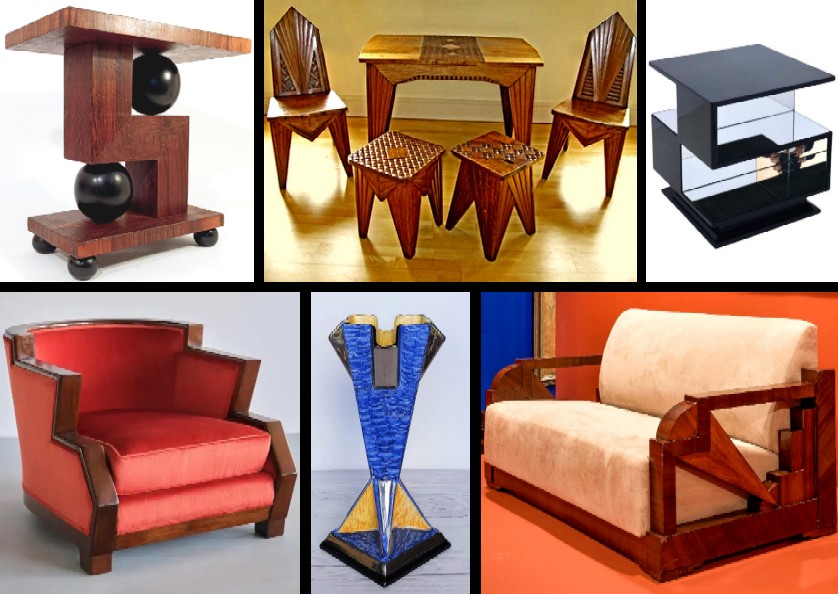
Examples of International Art Deco era Furniture with Cubist Elements, from left - Side Table, Walnut, Attributed to Osvaldo Borsani for Guido Pennati, Italian, 1930s, Pamono; able, Stools and Chairs, From the Polish Pavilion at the 1925 International Exhibition of Decorative Arts, Paris, Mieczyslaw Kotarbinski, 1925, Artnet; Side Table, Black Lacquered Wood and Mirror, French, c.1930, Pamono; Armchair, Maple with Mohair Velvet Upholstery, Belgian, 1920s, 1st Dibs; Vase, Hand Painted Ceramic, Etonia Ware, English, 1930s, Haute Curature; Couch, Museau de Arte Moderna de Sao Paulo, John Louis Graz for Fuliva and Adolpho Lerner, 1920s, Google Arts and Culture
Sources Not Mentioned Above:
"Cubism", Wikipedia, gathered 5-13-25
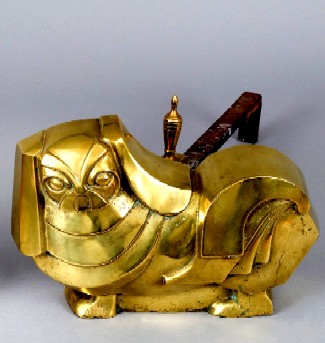
Pekinese Dog Andiron (One of a Pair), Brass and Wrought
Iron,
American, 1930s, Susan Silver Antiques"Czech Cubism", Wikipedia, gathered 5-13-25
"Czech Cubism", Google Arts & Culture, gathered 5-13-25
"Rondocubism", Wikipedia, gathered 5-16-25
Tamara Moscowitz, "1903-1932: Wiener Werkstätte & 1907-1914: Cubism", Interior Design, gathered 5-15-25
"Pablo Picasso and the Cubism movement in the Art Deco period", Berganza Limited website, gathered 5-15-25
Marie Rakušanová, "Is the Cubism that is Czech Also Universal? Czech Art Theory (1921–1958) and Cubism as a Cultural and Transcultural Phenomenon", The Courtauld website, gathered 5-13-25
Eleanor Moseman, "Skupina výtvarných umělců (The Group of Fine Artists), Routledge Encyclopedia of Modernsim", gathered 5-15-25
"The House at the Black Madonna", The Museum of Deocrative Arts in Prague website, gathered 5-16-25
"Josef Holeček, Czech Cubism - 1920s", Modernista website, gathered 5-16-25
"Czech Cubist Interiors", Fostinum website, gathered 5-16-25
"Svaz československého díla" Czech Wikipedia, gathered 5-19-25
Jarod Goss, "French Art Deco", The MET, gathered 5-13-25
"'David-Weill' Desk", The MET, gathered 5-13-25
"Pierre Chareau | A Lyrical Machine and Master of Materials", Beyond Shelter website, gathered 5-16-25
Original Cubism Facebook Posting - Original Czech Cubism Facebook Posting - Original Rondocubism Group Posting