
Isidore Odorico (1893 - 1945)
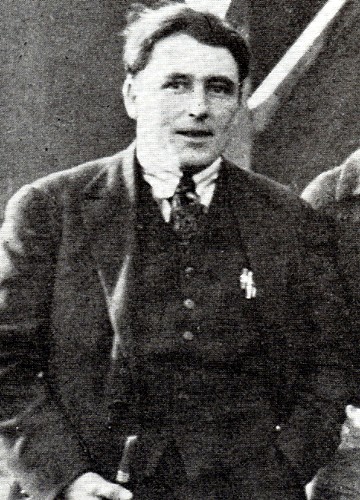
Isidore Odorico, 1925
Isidore Odorico (1893 - 1945) was born in Rennes, France to a family of Italian immigrants who had settled in France after his father Isidore and uncle Vincent came there to work on mosaics for the new Opéra Garnier in Paris for Italian mosaicist Giandomenico Facchina. Facchina developed a new method for installing mosaics. Designs were assembled in reverse on a temporary surface, such as glue-coated Kraft paper, and then transferred to their permanent location. This allowed them to be created faster and cheaper, increasing the market for mosaics in private homes.
The Opéra was completed in 1875. The brothers eventually left Paris, settling first in Tours in 1881 and eventually settling in Rennes in 1882 where they apparently started their own mosaic company, ‘Odorico Freres’ (Odorico Brothers). The advertised mosaic floors made of marble, enamel and gold as well as terrazzo. His uncle died childless in 1909 and his father died three years later.
Isidore (the younger) attended the regional school of fine arts in Rennes between 1908-13. Upon the death of Isidore (senior) his wife Marguerite and sons Vincent and Isidore assumed the running of the mosaic business. When the First World War began, Isidore was conscripted, serving in the 41st Infantry Regiment in Rennes. He was a prisoner of war in Dormstadt, Germany between 1916 and 1918. There he was exposed to the avant-garde artists of the Mathildenhöhe Dormstadt, one of the centers of Jugendstil design (German Art Nouveau).
Returning to Rennes after the war, Isidore resumed working for Odorico Brothers, making drawings and designing patterns based in part on what he had seen in Germany. His skills in design and business management helped propel the company. “Talented, ambitious and an outstanding business leader, Isidore is appreciated by local notables, enjoying a lot of popularity due to his involvement with Stade Rennais [football aka ‘soccer’] team. He did not hesitate to accept all public and private contracts…” (“La Bretagne d’Isidore Odorico”, Bretagne Actuelle website, gathered 2-11-26) Vincent, afflicted with scoliosis, was in charge of accounts and the administration of the company.
In 1922, Isidore married Marcelle Favret, daughter of the

Villa Carhuel Terrace at Etables-sur-Mer Balcony Photo: Danie Enocq, Unidiverse
mosaicist and terrazzo specialist Pietro Favret with whom he collaborated with on several projects. Being in fashion during the interwar period, Odorico collaborated with a variety of architects in and around Brittany. These included
- Jean de La Morinerie - Villa Carhuel in Étables-sur-Mer (1925)
- Emmanuel Le Ray - Nurseries in Rennes
- Léon Guinebretière - The public baths in Laval (1926)
- Roger Jusserand - The "Blue House" in Angers (1927)
- Georges Robert Lefort - Grand Seminary of Saint-Brieuc (1924-8)
- Hyacinthe Perrin - Sainte-Thérèse church (1933)
Because he was friends with the postal architect Pierre Laloy, Isidore was also hired for several mosaic projects at post offices including those at Saint-Lunaire (1927), Rennes-République (~1929), Tréguier (1935) and Cancale (1935). With so many opportunities available to the company, three branches were opened in Western French cities in the 1930s: Angers, Nantes and Dinard. At the height of demand, Odorico managed around 100 mosaic craftsmen.
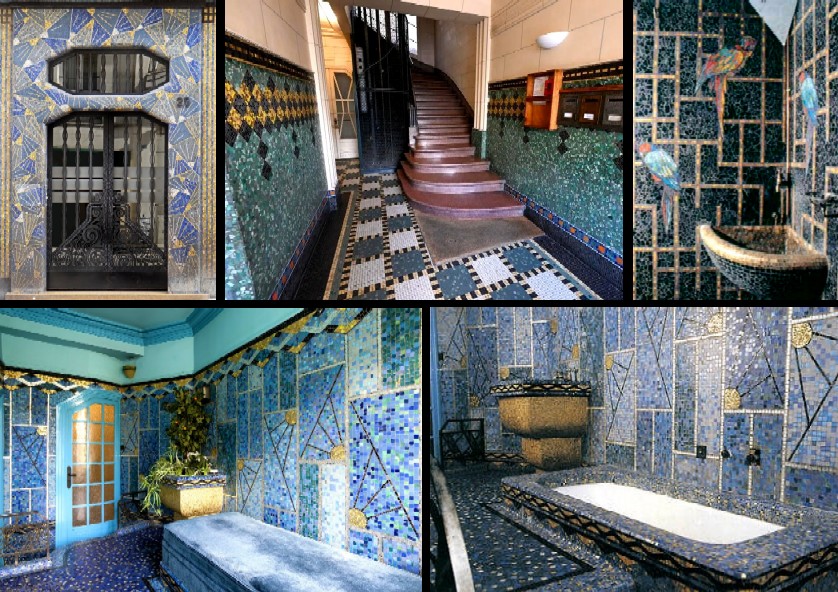 La Maison Bleue (Angers) Mosaics from 1929: <Top> Entrance on Rue d'Alsace, Photo: Jean-Pierre Dalbera, 1927. Wikimedia; Main Floor Stairwell, Angers Maiville; Parrot Sink, Angers.fr
<Bottom> Apartment Bathroom 1, Shorthand Social; Apartment Bathroom 2, Cirkwi
Some of the other notable Odorico mosaic projects undertaken by Odonot mentioned include:

Compagnie française d'Aviation Floor, 1938, Charcuterie-Greber
- The basement mosaics in Saint-Georges public swimming pool and baths in Rennes (1923-6)
- The Hôtel-Dieu in Rennes (c. 1925)
- Reception rooms in the Hôtel d'Anjou in Angers (1928)
- Floor mosaics in the Armoric Hotel in Trégastel (1930)
- Poirer Building facades (1931)
- Town hall vestibule of Perros-Guirec (1933)
- Student housing interiors at Cité Universitaire in Rennes (1935)
- The floors and staircase at the French Aviation Company in Angers (1938).
This is only a listing of the of the Odorico project highlights. The company created mosaic floors and walls for a variety of homes, businesses and government buildings, signs, swimming pools, public baths, and school among others. Some of the most beautiful mosaics are found in bathrooms, conservatories and other spaces only found in private homes.
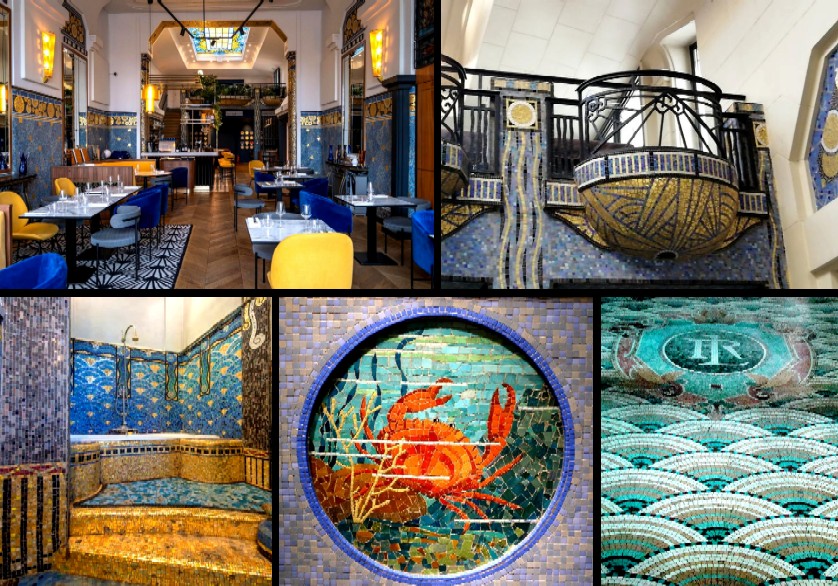 Various Odorico Brothers Mosaics: <Top> Hôtel d'Anjou Dining Room, Angers, 1928. Best Westerm d'Anjou; Hôtel d'Anjou Balconies, Angers, 1928, .Charcuterie-Greber
<Bottom> Odorico, Private House Bathroom, Facebook (Note: Despite what the source says, this does not appear to be at Maison Bleue); Place Sainte-Anne ( Former Fish Shop), Rennes, Photo - Danie Enocq, Unidiverse; Quay Lamennais Park, Rennes, Wiki Commons
Vincent died in 1934 but Isidore kept the business going as indicated by the number of tprojects undertaken after that. Odorico Brothers continued to produce mosaics up until France entered the Second World War. One source suggests that Isidore was again mobilized which is quite possible although he would have been 46 years old. After serving, he returned to Rennes where he died in 1945. Odorico Brothers continued to operate without any of the family being involved until it closed in 1979 when mosaics were no longer popular.
During the interwar period, Odorico Brothers propelled Rennes into a major center for French mosaic production; their mosaics were found in 122 cities in the Greater West. Odorico’s mosaics exemplify the Art Deco synthesis of craftsmanship, modern design, and public utility, helping to redefine decorative arts as integral to everyday architecture. Renewed interest in Odorico’s mosaics reflect a broader reevaluation of early twentieth-century decorative arts. Several of their mosaics which had been covered over or damaged have since been restored and repaired.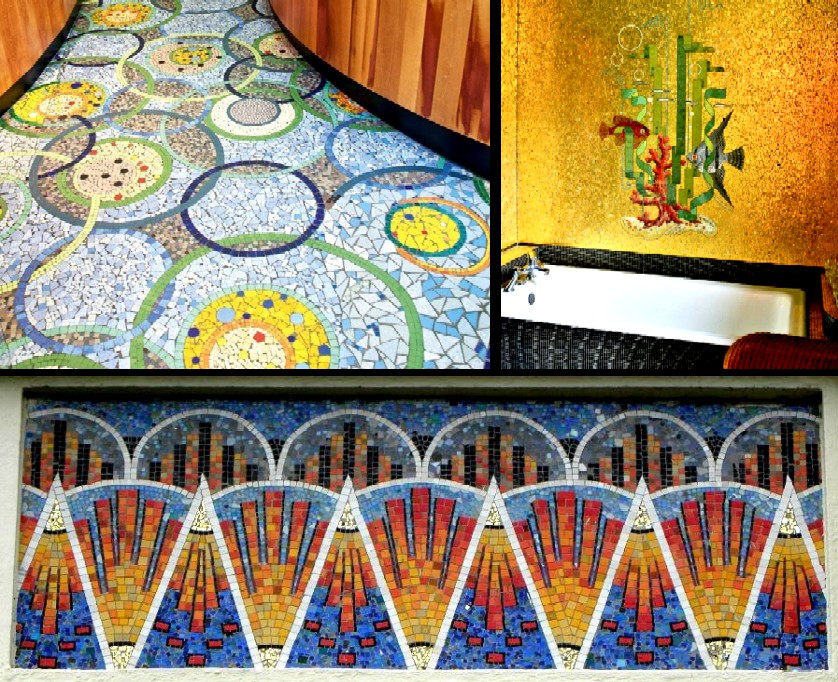 Various Odorico Brothers Mosaics: <Top> Town hall Square Shop Floor, Rennes, Elle France; Maison d'Odorico Bathroom, Rennes, 1930, Tourisme-Rennes
<Bottom> Odorico, Morel & Gâté Factory, Fougères, 1927, Bretagne-Actuelle

Hôtel d'Anjou Stairway, Angers, 1928
Sources Not Mentioned Above:
“Isidore Odorico”, French Wikipedia, gathered 2-8-26
“Isidore Odorico (1893 - 1945) & Edgar Brandt (1880 -1960)”, Capitolium Art website, gathered 2-10-26
Rachel, “Art-Deco mosaic style”, Stuc & Mosaic Workshop website, gathered 2-10-26
Claudine Penou, “Odorico, une famille qui a élevé la mosaïque artisanale au rang d’art”, sdbpro.fr, gathered 2-10-26
“Stade Rennais FC”, Wikipedia, gathered 2-11-26
“Pietro Favret”, French Wikipedia, gathered 2-11-26
Laure Le Fur, “Brittany's capital revives forgotten heritage: Italian mosaics”, Art Daily website, gathered 2-12-26
“Let us tell you the story of the Blue House”, Angers website, gathered 2-12-26 -
“FR36P: Isidore Odorico”, DMG-Lib website, gathered 2-8-26
"La Fabuleuse Odyssee Odorico", Shorthand Social, gathered 2-12-26
Caroline Morice, "The Odorico mosaics by Daniel Enocq: a heritage still to be saved", Universe website, gathered 2-13-26
Original Facebook Group Posting
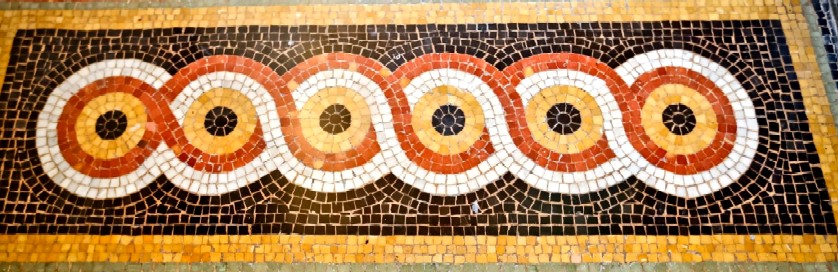 Floor Mosaic, Unknown Location in Rennes, Photo - Julien Mignot, Ille & Vilaine Tourisme