Alfonso Iannell (1888–1965)
“The reasonable way is the artistic way. Art is the sense of fitness.” (Chicago Art Institute Catalog for the Alfonso Iannelli Exhibition, Dec. 1925 – Jan. 1926)
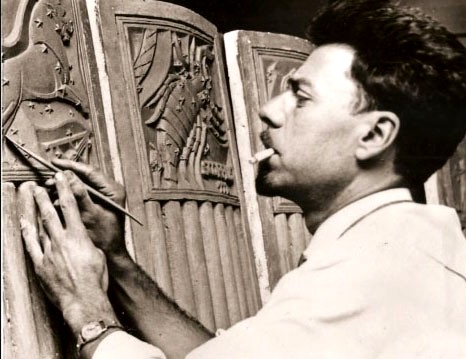
Alfonso Iannelli Working on Zodiac Symbols for Adler Planetarium, late 1920s,
From the
Chicago Seminar website
Alfonso Iannelli was born on February 17, 1888, in Andretta, Italy. Seeking better economic opportunities, the Iannellis emigrated to the United States and settled in Newark, New Jersey when Alfonso was about ten years old. His father was a cobbler which exposed him to manual craftsmanship and practical design. In 1901, he was apprenticed to a jewelry factory. Not long after, he received a scholarship to study at the Newark Technical School which led to his designing jewelry during the day and attending classes at night for the next three years. During the third year, he won a scholarship to the Art Students League of New York causing him to quit his apprenticeship and move to New York.
At the Art Students League, Iannelli studied under several well-known instructors, including Gutzon Borglum and George Bridgman. The League emphasized a rigorous academic training that combined anatomical study, life drawing, and sculptural modeling. Within two months, Borglum made Alfonso an assistant in his studio. At the end of his first year at the school, he won the St. Gaudens prize for sculpture and Borglum's prize for general work in composition, design and sculpture. Iannelli spent five months assisting Borglum with sculptural work for the Cathedral of St. John the Divine in New York.
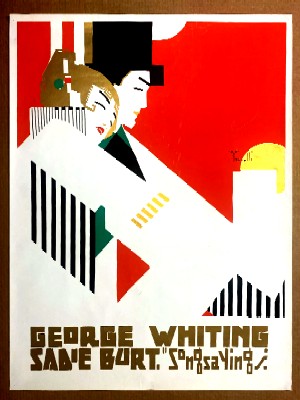
George Whiting - Sadie Burt, Designed 1910-15, 1968
Silk Screen Reprint, Golden Age Posters
In 1907, Iannelli began establishing himself as a professional artist, setting up a studio in New York and contributing artwork to magazines such as Colliers, Harpers Weekly and Ladies Home Journal in addition to doing work for Borglum. He moved to Cincinnati in 1908 to work as the chief designer for a lithographer where he began to see that art and functional design were not separate leading to a belief that commercial art was just as valid an artistic endeavor as studio art. His future work in industrial design was another manifestation of this belief.
Becoming restless in Cincinnati, Iannelli "decided to go West to get away from all so-called art and find what there was inside of me". (Joseph Griggs, 'Alfonso Iannelli, The Prairie Spirit in Sculpture”, The Prairie School Review, Vol II, No. 4, 1965, p. 7) Arriving in Los Angeles in 1910, he opened a small design studio. He also become an art instructor at the Los Angeles Sketch club between 1911 and 1913. His California is best known by the lobby showcard posters he designed for the windows of the new Orpheum Theater between 1912 and 1915 during which he said he created "four or five a week" with five displayed for current attractions and five for those coming. It is believed that he created around a hundred posters in all. Iannelli explained, "As the experiments progressed, the shapes became simpler, the colors clearer, until the forms were geometricized in pure colors....From this point the work was more satisfactory.: ("The Art of Alfonso and Margaret Iannelli", WTTW website, gathered 3-20-26). The more abstracted geometric figures he used in combination with dramatic color contrasts projected what he called ‘the vaudeville spirit’. The striking posters caught the interest of Frank Lloyd Wright’s sons John and Lloyd and architect Barry Byrne.
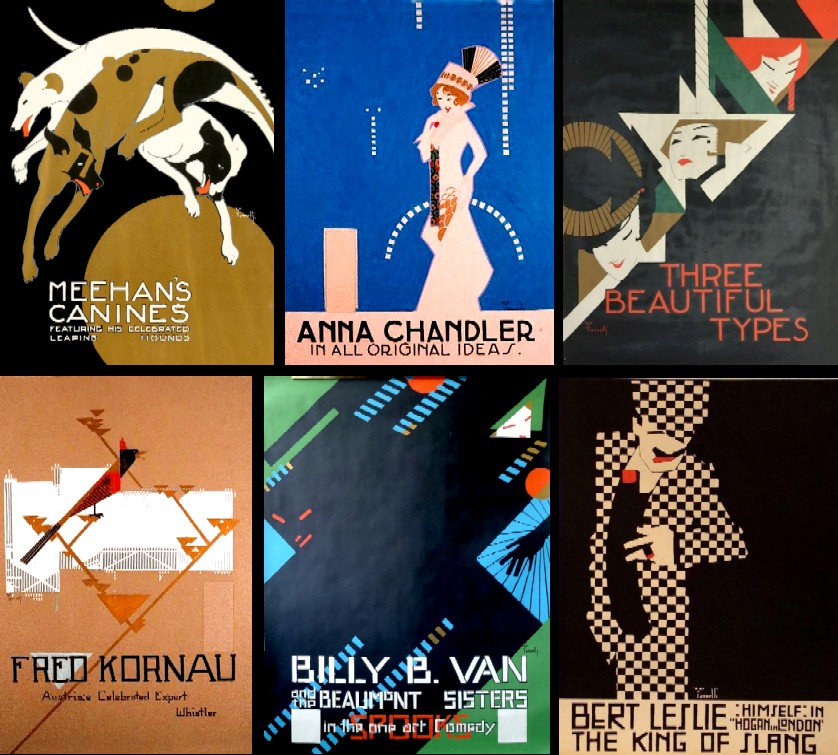
New Orpheum Theaterer Vaudville Posters from 1914-5: <Top> Mehan's Canines, Designed 1914, 1968 Reprint, Bidsquare; Iannelli, Anna Chandler in All Original Ideas, Designed 1915, WTTW website; Three Beautiful Types, Designed 1914, 1969 Reprint, Bidsquare
<Bottom> Fred Kornau - Austria's Celebrated Whistler, Designed 1914, WTTW website; Billy B. Van and the Beaumont Sisters, Designed 1915, 1960s Silk Screen Reprint, Ebay; Bert Leslie - The King of Slang, Designed 1915, WTTW website;
John Lloyd Wright introduced himself to Iannelli
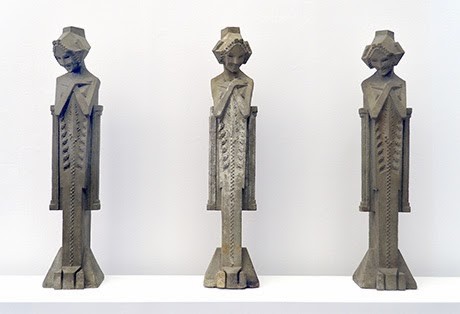
Sprites or Spindles, Concrete, From Midway Gardens, Created 1913-4, Alchetron
who showed him around his studio which contained some partially complete statues. Wright recommended him to architect Harrison Albright who commissioned him to create four statues for his Workingman’s Hotel project. When John returned to Chicago in 1913, he recommended Alfonso to his father who was developing an ambitious entertainment complex in Chicago known as Midway Gardens. Frank Lloyd Wright invited Iannelli to contribute sculptural elements to the project.
Completed in 1914, Midway Gardens featured a series of distinctive, Cubist-inspired sculptural figures known as the “Sprites,” which were integrated into the building’s architecture. Although Wright later claimed design credit for the sculptures, subsequent scholarship recognized Iannelli’s role in their creation. This bit of plagiarism marked an end to their direct relationship. Wright asked him to create sculptures for his Imperial Hotel project in Japan which Alfonso refued. Still, the project marked a turning point in his career, establishing his reputation as a sculptor capable of integrating modern sculpture with architectural design. He settled in the Chicago area following the Midway project in 1915, where he would spend most of his career.
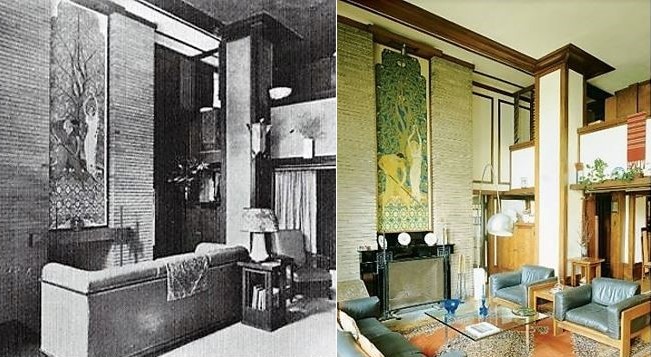
The Tree of Life Mural for the John B. Frank House, Past and Present, Completed 1916, Facebook
Iannelli collaborated with several architects associated with progressive architectural movements. Some of his most significant partnerships were with Barry Byrne and the architectural firm Purcell & Elmslie. They were associated with the Prairie School, a movement that emphasized horizontal forms, natural materials, and the integration of decorative elements with architectural structure. Alfonso began working with Byrne immediately after settling in Chicago. He created the Tree of Life mural at the house Byrne designed for John B. Frank in Fort Wayne, Indiana in 1914. As the two worked together, Byrne had him design a variety of elements in his architectural projects including color schemes, light fixture and carpet designs for his projects. The majority of their collaborative projects were schools and churches built between 1923 and 1928 with Alfonso even influencing the architecture on some projects.
His best known project with Purcell & Elmslie was the Woodbury County Courthouse in Sioux City which was finished in 1918. He designed the sculptural decoration for the entrance of the courthouse which reflected the role of law in society.
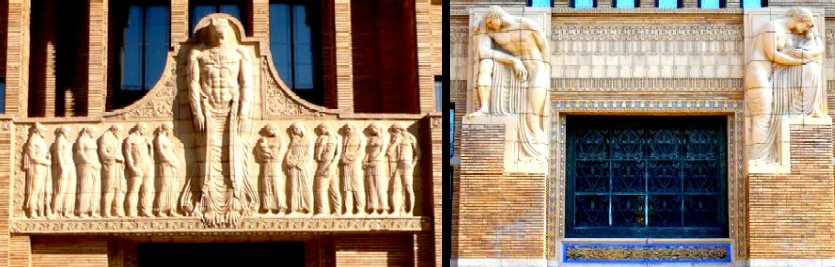
Woodbury County Courthouse Entrance Sculptures, Sioux City, IA, 1918: Douglas Street Entrance, Spirit of Law Surrounded by the Community, Travel Iowa; 7th Street Entrance, Justice and Humanity, Mister Dangerous
During the early 1920s, Iannelli and his wife Margaret
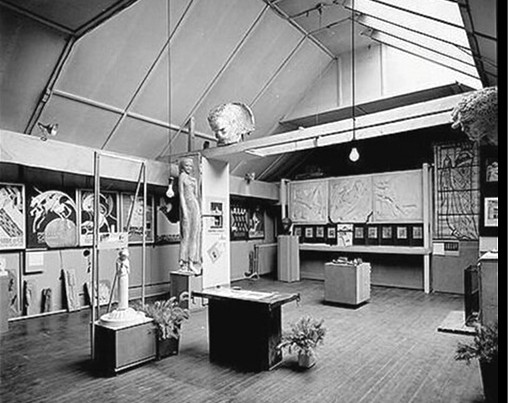
Park Ridge Studio, Sculptures, Posters, Reliefs and Stained Glass, c. 1925, Edgar Miller
Spaulding Iannelli moved to Park Ridge, Illinois, a suburb of Chicago. They established Iannelli Studios, a multidisciplinary design workshop which produced architectural sculpture, graphic design, industrial design, and exhibition displays. This reflected the modernist belief that artistic creativity should extend beyond traditional fine arts into everyday objects and environments. It was a collaborative space where artists, architects, and designers could experiment with new forms of modern design.
Iannelli continued to be involved in art education during the 1920s, teaching at the School of the Art Institute of Chicago. He created a program to establish a department of industrial design while teaching there in 1923. He became the director of the school’s Department of Design in 1928 which was sponsored by the Association of Arts and Industries. This position placed him among the pioneers advocating for the integration of art, engineering, and manufacturing in American design education. “There was apparently considerable opposition in the school to the idea of setting up workshops in which student-designers would have an opportunity to deal with actual materials and machine processes.” (Griggs, p. 20) As a result, Iannelli resigned his position and the Association withdrew their support.
One of his most notable projects from the late 1920s was his work for the Adler Planetarium in Chicago, with the building being completed in 1930 as designed by Ernest A. Grunsfeld III. The building featured a series of bronze relief plaques designed by Iannelli representing zodiac symbols and mythological planetary figures in Art Deco style. They were seamlessly integrated into Grunsfeld’s architectural design, reinforcing the astronomical theme of the planetarium.
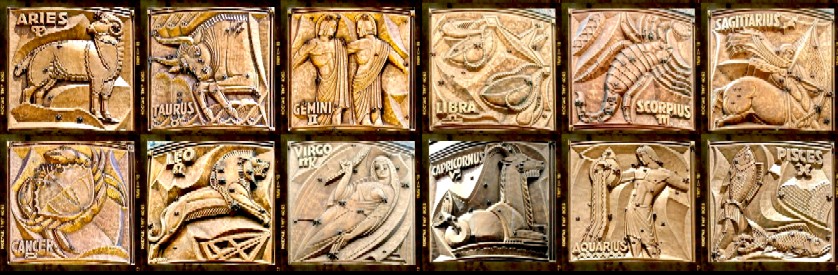
The Zodiac Symbol Reliefs on Adler Planetarium in Chicago, IL, US, 1930, Original Images from Driving for Deco
During the 1930s Iannelli increasingly focused on industrial design as manufacturers embraced the idea of producing more aesthetically pleasing consumer products. He began working in this field in the mid-1920s. Among the companies who commissioned him were Sunbeam Corporation, Birtman Electric Company, Fairbanks, Morse & Company, Mueller Plumbing Company, Wahl-Eversharp and Parker. For Eversharp, his studio designed the Coronet fountain pen.
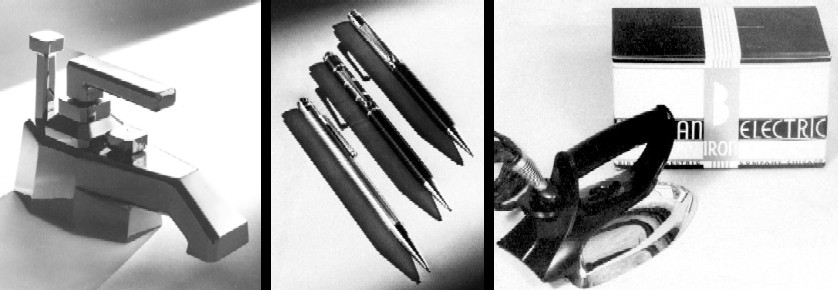
Iannelli's Industrial Designs for Manufacturers in the 1930s, From The Chicago Design Archive: Prototype Faucet Design for Mueller Company, 1931; Mechanical Pencils for Wahl-Eversharp Company, 1937; Iron Deluxe for Birthman Electric, 1933
For the 1933-4 Chicago Century of Progress International Exposition Iannelli’s studio was involved in several exhibition pavilions and displays. Projects created by the studio included both architectural and graphic designs, reflecting the interdisciplinary nature of his studio. Among his architectural contributions was the Radio Entrance façade for the Social Science hall, the Radio Flyer pavilion, the Havoline Motor Oil Thermometer building as well as parts of the Enchanted Island's "Magic Mountain". He also designed graphics and sculptures used at the Exposition.
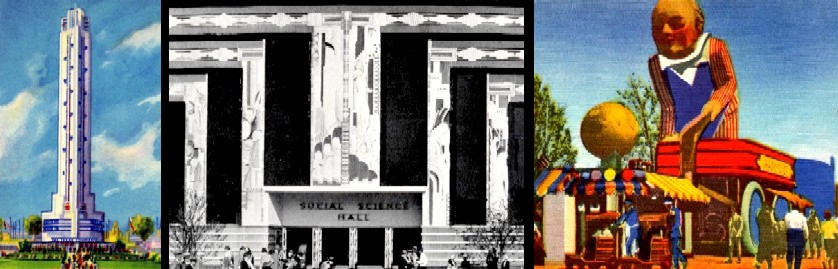 Iannelli's Century of Progress Exhibits, Chicago, IL, US, 1933: Havoline Thermometer Building, Calisphere; Radio Entrance, Social Science Hall, From Sculpture Brochure, 1933, p. 23; Radio Flyer Building, Magic Mountain, Online Bicycle Museum
While not involved in architectural
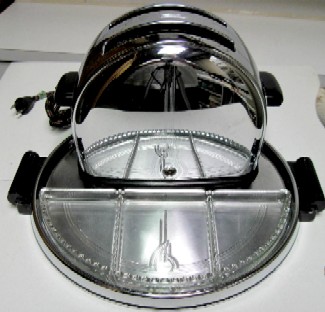
T-9 Sunbeam Toaster with Tray and Condiment Insert,
Chromed metal and Bakelite, 1939, Worthpoint
projects for the 1939 World’s Fair in New York, Sunbeam introduced Iannelli’s Streamline Moderne C-20 ‘Coffeemaster’ vacuum coffeemaker and his T-9
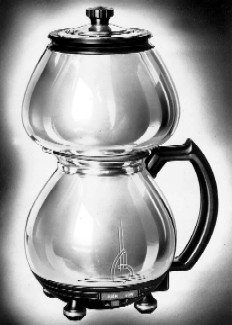
C-20 Coffeemaster Vacuum Coffee Maker
Ad, 1939, The Chicago Design Archive
electric toaster. While they were designed before the fair (some toasters have a date of 1937 stamped on the inside), they are said to have appeared for sale to the public after they were introduced at the fair. Both bear what appears to be a stylized version of the fair’s Trylon and Perisphere. Although these designs link to the fair is uncertain, their introduction there is rather suggestive.
Iannelli continued to create graphic, architectural and product designs during the 1940s and 1950s, helping his apprentices to create their designs. During the 40s and early 50s, he created industrial designs for Sunbeam, H. H. Bryan and John Oster Manufacturing Company, among others. When his student Marcelline Gougler’s 'Fountain of the Pioneers' design beat 22 other entries for the Kalamazoo Business and Professional Women’s Club contest, he helped her engineer it in 1940. His last commission is believed to be the Rock of Gibraltar bas-relief for the Prudential building in Chicago, completed in 1955.
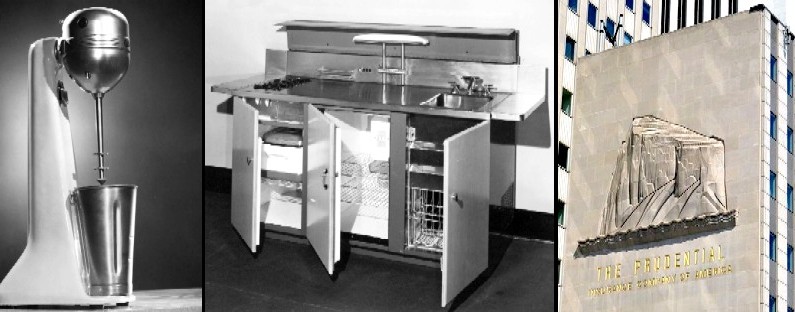 Iannelli Projects from the 1940s & 50s: Electric Drink Mixer, John Oster Manufacturing Company, 1940, The Chicago Design Archive; 'Invisible Kitchen' Kitchenette, H. H. Bryan Company, 1948, The Chicago Design Archive; Rock of Gibralter Design for Prudential Health, 1955, Alchetron
Sources Not Mentioned Above
Loren Lerner, American Art and Architecture of the 20th Century,
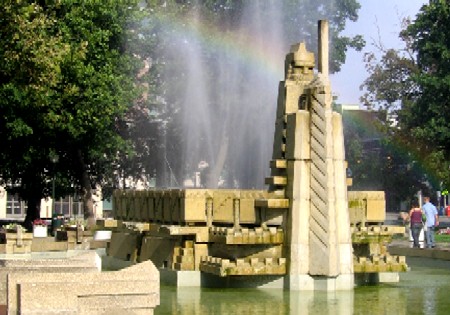
Fountain of the Pioneers, Kalamazoo, Michigan, Marcelline Gougler assisted by
Alfonso Iannelli, 1940, Michigan Modern
Chicago: University of Chicago Press, 2007
Linda Flint McClelland, “Alfonso Iannelli and the Integration of Art and Architecture.” Journal of the Society of Architectural Historians 69 (2), 2010, pp. 178–195.
“Alfonso Iannelli”, Chicago Center for the Print website, gathered 3-15-26
“Alfonso Iannelli”, Michigan Modern website, gathered 3-15-26
“Alfonso Iannelli collection: Biographical Note”, University of Minnesota Libraries website, gathered 3-15-26
“Art of Alfonso and Margaret Iannelli on Loan from Tim Samuelson, Chief Historian of the City of Chicago”, Ingersoll-Blackwelder House website, gathered 3-15-26
“Alfonso Iannelli: A Sculptor of Streamline and Spirit”, Wahoo Art website, gathered 3-15-26
“Grand Opera House (Los Angeles)”, Wikipedia, gathered 3-15-26
“Alfonso Iannelli”, Wolfs Gallery website, gathered 3-16-25
Jennifer Johnson, “Remodeling gives Park Ridge’s Iannelli Studios historically accurate look, local historian says”, Chicago Tribune, February 12, 2021, gathered from the internet 3/20/26
Quinn Myers, “Ask Geoffrey: An Identity Crisis For Prudential Plaza?” WTTW website, gathered 3-20-26